Welcome to diabetes health. Online
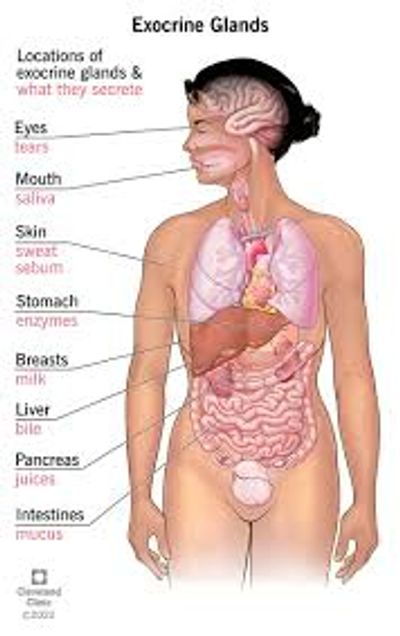
Exocrine system
The exocrine system is a collection of glands that produce and release fluids and substances through a duct or opening onto the body surface.
Members of the exocrine system
Your lacrimal glands are your tear glands. Your lacrimal glands are located above your upper eyelids. They create and secrete tears, a fluid that gets into your eyes every time you blink. This fluid helps keep your eyes moisturized.
Your salivary glands create and secrete saliva. Salvia helps you chew, swallow and digest your food. It also helps lubricate and protect the inner lining of your tissues. Salivary glands are located in the head and neck, and are found in three main pairs around the mouth and under the tongue. The parotid glands which are the largest salivary glands, are located in front of and slightly below each ear. The facial nerve passes through the parotid glands. Submandibular glands are Located under the jaw, on either side of the face. Sublingual glands are Located under the tongue, on either side of the mouth.
Mammary glands are located in the female breast, and the milk is nutrient-rich and helps protect your baby’s developing immune system.
The ceruminous glands are located in the ears. They help produce ear wax (cerumen) which helps protect your ears from physical damage and infection.
Stomach glands reside in the gastric mucosa, which is the innermost layer of the stomach wall. They release enzymes that help break down food. They also help your body absorb important nutrients.
The Brunner glands are located in the duodenum, the first part of your small intestine. The Brunner glands produce mucus that protects your duodenum from stomach acid. They also help your body digest food and absorb nutrients.
The Liver Produces bile, which is stored in the gallbladder and released into the duodenum which aids in digestion. Your liver is located on the right side of your body in the upper right abdomen below your ribcage. The liver is considered both an endocrine and exocrine gland.
The pancreas is located in the upper abdomen, behind the stomach and in front of the spine, at the level of the front ribs. The Pancreas is considered both an endocrine and exocrine gland. The Pancreas Produces pancreatic juices, which contain the digestive enzymes amylase, lipase, and protease. Amylase helps break down complex carbohydrates like starch into simpler sugars.
Lipase Works with bile from the liver to break down fats into fatty acids. Protease breaks down proteins into amino acids.
The sebaceous glands Produce oil, or sebum, to lubricate and protect the skin. Your sebaceous glands are in your skin, but they also open into your hair follicles.
Sweat glands cover almost your entire body surface. Sweat glands produce clear, non-oily sweat that helps control your body temperature by cooling it.
The effects of diabetes on the exocrine system
The lacrimal glands due to Diabetes produce fewer tears. Low insulin levels can lead to decreased tear production. High blood glucose can damage the nerves in the eyes, including the nerves in the lacrimal gland. This can limit blood flow to the area, which can lead to decreased tear production. Diabetes can lead to dry eye disease, a condition characterized by an unstable tear film and inflammation. Up to 54.3% of people with diabetes experience dry eye disease. Symptoms of dry eye disease include blurry vision, heavy eyelids, difficulty opening the eyes, and tired eyes. Inadequate insulin levels in the body can lead to decreased tear production.
Saliva production can be affected by diabetes in a number of ways. Diabetes can cause Polyuria which is an increase in urine volume to eliminate excess sugar from the blood, which can lead to a decrease in saliva production. Diabetes can alter the composition of saliva, increase the concentration of calcium and decrease the levels of magnesium, zinc, and potassium. Symptoms of diabetes in relation to saliva production is Dry mouth, Difficulty swallowing, Pain or burning in the mouth or throat, rough tongue, Sticky, thick, or stringy saliva.
The mammary glands are affected by diabetes in several ways such as by causing a condition called "diabetic mastopathy," which manifests as hard, painless, fibrous masses in the breast that can sometimes be mistaken for breast cancer, although they are non-cancerous; this occurs due to the abnormal proliferation of tissue in the breast related to poor blood sugar control in diabetic individuals. The exact cause is not fully understood, but it is believed to be related to changes in blood flow and tissue metabolism associated with poorly managed diabetes. Diabetes can also affect lactation by potentially impacting milk production due to the role of insulin in mammary gland function.
The Ceruminous glands Is affected by diabetes as it is known to cause infections which can damage the ear and lead to hearing loss.
Stomach enzyme creation is indirectly affected by diabetes by damaging the nerves in the stomach, leading to a condition called gastroparesis, which slows down the stomach's ability to move food through the digestive tract, potentially impacting the normal release and function of digestive enzymes. This may lead to impaired digestion and therefore the malabsorption of nutrients.
The Brunner glands are affected by diabetes primarily causing an increase in their size and number, a condition known as Brunner's gland hyperplasia, due to the altered microenvironment within the duodenum caused by high blood sugar levels, potentially leading to increased mucus production and potential digestive issues; however, the exact mechanisms are still being studied.
The exocrine portion of the pancreas is affected by diabetes as People with diabetes have an increased risk of developing Exocrine pancreatic insufficiency (EPI, a condition in which the pancreas doesn't produce enough digestive enzymes. EPI can lead to deficiencies in vitamins and minerals, as well as uncomfortable gastrointestinal symptoms. Pancreas damage can lead to reduced release of digestive enzymes into the intestine, which can impair nutrient digestion. In children and adults with type 1 diabetes, the pancreas can be reduced in size by 20–50% compared to nondiabetic controls. This could be due to atrophy, impaired organ growth rate, or a combination of both.
Sebaceous gland structure and function may be compromised in people with diabetes due to insulin resistance and hyperglycemia. Insulin is essential for optimal sebaceous gland activity, and hyperglycemia can contribute to lipolysis in adipocytes, which could reduce the quality of meibum. An excessive sugar intake can lead to insulin spikes, which may trigger an increase in androgens (male hormones). Elevated androgen levels can stimulate the sebaceous glands in your skin, leading to an overproduction of oil and a higher risk of acne breakouts. Dysfunction of the sweat and sebaceous glands can cause dry and itchy skin. Itching can be caused by a yeast infection, dry skin, or poor circulation.
Sweat glands can be affected by both diabetes and hypoglycemia in several ways. Also known as hypoglycemia, low blood sugar can cause excessive sweating. When blood sugar levels drop too low, the body produces more adrenaline, which triggers the fight-or-flight response and leads to sweating. Other symptoms of hypoglycemia include dizziness, headaches, shaking, and difficulty concentrating. Also known as diabetic neuropathy, nerve damage from diabetes can affect the nerves that control sweat glands. This can lead to excessive sweating, known as hyperhidrosis, or insufficient sweating. People with diabetes-related hyperhidrosis may sweat more than others in cool environments, while trying to warm up, or during times of stress or little activity. People with diabetes are more likely to experience gustatory sweating, which is sweating that occurs while eating, smelling, or thinking about food. This type of sweating usually appears on the forehead, scalp, neck, and upper lip. People with diabetes can become dehydrated more quickly. Diabetes complications can affect the body's ability to cool itself, which can lead to heat exhaustion and heat stroke. Heat stroke is a medical emergency. Sweat from people with diabetes may also smell like ammonia. Antiperspirants can help reduce sweating, and deodorants can help cover up odors.
Nutrients that positively impact the exocrine system members
Lacrimal glands
Nutrients necessary for the lacrimal glands to remain in homeostasis
Vitamin A, Omega-3 fatty acids, B1, B2, B12 and Vitamin D.
Mammary glands
Nutrients necessary to keep the mammary glands in homeostasis
glucose, Protein, calcium, omega 3 fatty acid, alpha-linolenic acid and vitamin A.
Ceruminous glands
Nutrients necessary to keep the Ceruminous glands in homeostasis linoleic acid (omega-6), A, E, B2, B3, and B5. These are crucial components of earwax, providing lubrication and a barrier against foreign particles.
The stomach glands
To maintain stomach gland homeostasis, the most crucial nutrients are vitamin B12 (cobalamin), which requires intrinsic factor produced by the stomach for absorption, along with iron, calcium, and magnesium as proper stomach acid levels are necessary for their absorption as well; vitamin D also plays a role in regulating gastric epithelial cell function and homeostasis within the stomach lining.
Brunner glands
Brunner's glands primarily maintain homeostasis by secreting a mucus-rich alkaline fluid containing sodium bicarbonate which neutralizes stomach acid entering the duodenum, protecting the intestinal lining; therefore, the key nutrient supporting their function is sodium along with other electrolytes necessary for proper fluid balance and secretion production.
liver
To maintain liver homeostasis, key nutrients include fat-soluble vitamins (A, D, E, and K), B vitamins (especially B12 and folate), iron, copper, and adequate amounts of protein and fiber as they are essential for the liver's detoxification processes, storage functions, and overall metabolic balance; a balanced diet with antioxidants and healthy fats also supports liver health.
The exocrine pancreas
To maintain the exocrine pancreas in homeostasis, the most crucial nutrients include adequate protein, a balanced intake of complex carbohydrates and healthy fats, and sufficient levels of fat-soluble vitamins (A, D, E, and K), as well as essential minerals like calcium, magnesium, and zinc, which are necessary for proper enzyme production and function of the pancreatic cells. The inclusion of fat-soluble vitamins (A, D, E, and K) May require supplementation in cases of pancreatic insufficiency due to malabsorption issues. Always check with your doctor first.
The salivary glands
To maintain salivary gland homeostasis, key nutrients include water, electrolytes, vitamins A, B3, B9, B12, and antioxidants these elements contribute to the production of saliva with the correct composition and volume, essential for oral health and digestion.
The sebaceous gland
To maintain sebaceous gland homeostasis, key nutrients include vitamin A (retinoids), omega 3 fatty acid, essential fatty acids like linoleic acid (LA), zinc, and potentially vitamin E; these nutrients play a role in regulating sebum production, cell differentiation within the sebaceous glands, and maintaining healthy skin barrier function.
The sweat glands
To maintain the homeostasis of sweat glands, the most crucial nutrient is sodium (Na+) along with other electrolytes like potassium (K+) and chloride (Cl-), as these are actively transported across the sweat gland cells to regulate the composition of sweat, ensuring proper fluid balance and body temperature control; adequate hydration with water is also essential for proper sweat production.